[maps] Warning! The maps are automatically generated from the textual information, and the process does not always produce acceptable result; See about maps for more info.
Some related literature:
Dunn & Dunn, 1991
Review of Australian Butterflies: distribution, life history and taxonomy
Review Austr. Butts.
(1): 1-196,
(2): 197-335,
(3): 336-512,
(4): 513-660
Graham, 1988
The life history of a semi-arid population of Croitana croites (Hewitson) (Lepidoptera: Hesperiidae: Trapezinae)
Aust. Ent. Mag. 15: 123-126
Hewitson, 1874
Illustrations of new species of exotic Butterflies selected chiefly from the collections of W. Wilson Saunders and William C. Hewitson
Ill. exot. Butts [5]
: (Systematic Index) V,
(Anteros): [1-2], pl. [1] (1867),
(Erycina & Necyria): [3-4], pl. [2] (1870),
(Erycina Symmachia &c): [5-6], pl. [3] (1875),
(Necyria & Esthemopsis): [7-8], pl. [4] (1872),
(Calydna): [9-10], pl. [5] (1854),
(Calydna II): [11-12], pl. [6] (1859),
(Theope): [13-14], pl. [7] (1860),
(Symmachia): [15-16], pl. [8] (1867),
(Symmachia & Charis II): [17-18], pl. [9] (1871),
(Charis): [19-20], pl. [10] (1866),
(Emesis): [21-22], pl. [11] (1872),
(Nymphidium I): [23-24], pl. [12] (1853),
(Nymphidium II-III): [25-28], pl. [13-14] (1865),
(Nymphidium IV): [29-30], pl. [15] (1871),
(Lemonias I): [31-32], pl. [16] (1853),
(Lemonias II): [33-34], pl. [17] (1858),
(Lemonias III-IV): [35-38], pl. [18-19] (1863),
(Lemonias V): [39-40], pl. [20] (1872),
(Lemonias & Baeotis): [41-42], pl. [21] (1875),
(Lemonias & Baeotis): [43-44], pl. [22] (1874),
(Pachythone & Cremna): [45-46], pl. [23] (1873),
(Hades, Uraneis, &c): [47-48], pl. [24] (1870),
(Limnas I-II): [49-52], pl. [25-26] (1853),
(Limnas & Panara): [53-54], pl. [27] (1875),
(Limnas &c): [55-56], pl. [28] (1876),
(Limnas & Ithomeis): [57-58], pl. [29] (1870),
(Chamaelimnas & Ithomiola): [59-60], pl. [30] (1871),
(Hermathena &c): [61-62], pl. [31] (1875),
(Ogyris): [63-64], pl. [32] (1853),
(Pentila & Liptena): [65-66], pl. [33] (1866),
(Pentila & Liptena II): [67-68], pl. [34] (1873),
(Lycaena): [69-70], pl. [35] (1876),
(Pyrrhopyga I-II): [71-74], pl. [36-37] (1857),
(Pyrrhopyga): [75-76], pl. [38] (1869),
(Pyrrhopyga II-III): [77-80], pl. [39-40] (1871),
(Pyrrhopyga IV): [81-82], pl. [41] (1873),
(Pyrrhopyga V & Erycides): [83-84], pl. [42] (1875),
(Ismene I-II): [85-88], pl. [43-44] (1867),
(Eudamus): [89-90], pl. [45] (1873),
(Eudamus II-III): [91-94], pl. [46-47] (1875),
(Chaetocneme): [95-96], pl. [48] (1874),
(Hesperia I-II): [97-100], pl. [49-50] (1867),
(Hesperia III): [101-102], pl. [51] (1868),
(Hesperia IV): [103-104], pl. [52] (1869),
(Hesperia V): [105-106], pl. [53] (1872),
(Hesperia V*-VI): [107-110], pl. [54-55] (1873),
(Hesperia VII): [111-112], pl. [56] (1876),
(Leucochitonea): [113-114], pl. [57] (1869),
(Leucochitonea II): [115-116], pl. [58] (1875),
(Pterygospidea): [117-118], pl. [59] (1873),
(Cyclopides): [119-120], pl. [60] (1874),
(Cyclopides & Hesperilla): [121-122], pl. [61] (1874)
[BOW]; Lewis, 1974
Butterflies of the World
[AUCL]; Nielsen & Rangsi, 1996
Checklist of the Lepidoptera of Australia
Monogr. Aust. Lepid. 4: 1-529
Waterhouse, 1932
New genera of Australian Hesperiidae and a new subspecies
Aust. Zool. 7 (3)
: 198-201
If you have corrections, comments or
information to add into these pages, just send mail to
Markku Savela
Keep in mind that the taxonomic information is copied from various sources, and may include many inaccuracies. Expert help is welcome.
![[HOME]](../../../../../../../icons/home.gif)
![[INDEXES]](../../../../../../../icons/warp.gif)
![[TREE]](../../../../../../../icons/phylo.png) Life
Insecta
Lepidoptera
Ditrysia
Hesperioidea
Hesperiidae
Trapezitinae
Life
Insecta
Lepidoptera
Ditrysia
Hesperioidea
Hesperiidae
Trapezitinae
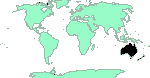 AU. See [maps]