[BOA] Interactive Listing of American Butterflies
Listado Interactivo de la Mariposas Americanas; Butterflies of America
[LEPIFORUM] Lepiforum; Bestimmung von Schmetterlingen (Lepidoptera) und ihren Präimaginalstadien
[maps] Warning! The maps are automatically generated from the textual information, and the process does not always produce acceptable result; See about maps for more info.
Some related literature:
Hewitson, 1857
Illustrations of new species of exotic Butterflies selected chiefly from the collections of W. Wilson Saunders and William C. Hewitson
Ill. exot. Butts [5]
: (Systematic Index) V,
(Anteros): [1-2], pl. [1] (1867),
(Erycina & Necyria): [3-4], pl. [2] (1870),
(Erycina Symmachia &c): [5-6], pl. [3] (1875),
(Necyria & Esthemopsis): [7-8], pl. [4] (1872),
(Calydna): [9-10], pl. [5] (1854),
(Calydna II): [11-12], pl. [6] (1859),
(Theope): [13-14], pl. [7] (1860),
(Symmachia): [15-16], pl. [8] (1867),
(Symmachia & Charis II): [17-18], pl. [9] (1871),
(Charis): [19-20], pl. [10] (1866),
(Emesis): [21-22], pl. [11] (1872),
(Nymphidium I): [23-24], pl. [12] (1853),
(Nymphidium II-III): [25-28], pl. [13-14] (1865),
(Nymphidium IV): [29-30], pl. [15] (1871),
(Lemonias I): [31-32], pl. [16] (1853),
(Lemonias II): [33-34], pl. [17] (1858),
(Lemonias III-IV): [35-38], pl. [18-19] (1863),
(Lemonias V): [39-40], pl. [20] (1872),
(Lemonias & Baeotis): [41-42], pl. [21] (1875),
(Lemonias & Baeotis): [43-44], pl. [22] (1874),
(Pachythone & Cremna): [45-46], pl. [23] (1873),
(Hades, Uraneis, &c): [47-48], pl. [24] (1870),
(Limnas I-II): [49-52], pl. [25-26] (1853),
(Limnas & Panara): [53-54], pl. [27] (1875),
(Limnas &c): [55-56], pl. [28] (1876),
(Limnas & Ithomeis): [57-58], pl. [29] (1870),
(Chamaelimnas & Ithomiola): [59-60], pl. [30] (1871),
(Hermathena &c): [61-62], pl. [31] (1875),
(Ogyris): [63-64], pl. [32] (1853),
(Pentila & Liptena): [65-66], pl. [33] (1866),
(Pentila & Liptena II): [67-68], pl. [34] (1873),
(Lycaena): [69-70], pl. [35] (1876),
(Pyrrhopyga I-II): [71-74], pl. [36-37] (1857),
(Pyrrhopyga): [75-76], pl. [38] (1869),
(Pyrrhopyga II-III): [77-80], pl. [39-40] (1871),
(Pyrrhopyga IV): [81-82], pl. [41] (1873),
(Pyrrhopyga V & Erycides): [83-84], pl. [42] (1875),
(Ismene I-II): [85-88], pl. [43-44] (1867),
(Eudamus): [89-90], pl. [45] (1873),
(Eudamus II-III): [91-94], pl. [46-47] (1875),
(Chaetocneme): [95-96], pl. [48] (1874),
(Hesperia I-II): [97-100], pl. [49-50] (1867),
(Hesperia III): [101-102], pl. [51] (1868),
(Hesperia IV): [103-104], pl. [52] (1869),
(Hesperia V): [105-106], pl. [53] (1872),
(Hesperia V*-VI): [107-110], pl. [54-55] (1873),
(Hesperia VII): [111-112], pl. [56] (1876),
(Leucochitonea): [113-114], pl. [57] (1869),
(Leucochitonea II): [115-116], pl. [58] (1875),
(Pterygospidea): [117-118], pl. [59] (1873),
(Cyclopides): [119-120], pl. [60] (1874),
(Cyclopides & Hesperilla): [121-122], pl. [61] (1874)
[NL4A]; Lamas, 2004
Checklist: Part 4A, Hesperioidea - Papilionoidea
Atlas of Neotropical Lepidoptera
[BOW]; Lewis, 1974
Butterflies of the World
Mabille, 1903
Genera Insectorum. Lepidoptera. Rhopalocera. Fam. Hesperidae
in Wytsman, Genera Insectorum 17
(A): 1-78 (1903),
(B): 79-142 (1904),
(C): 143-182 (1904),
(D): 183-210 (1904)
If you have corrections, comments or
information to add into these pages, just send mail to
Markku Savela
Keep in mind that the taxonomic information is copied from various sources, and may include many inaccuracies. Expert help is welcome.
![[HOME]](../../../../../../../icons/home.gif)
![[INDEXES]](../../../../../../../icons/warp.gif)
![[TREE]](../../../../../../../icons/phylo.png) Life
Insecta
Lepidoptera
Ditrysia
Hesperioidea
Hesperiidae
Pyrrhopyginae
Life
Insecta
Lepidoptera
Ditrysia
Hesperioidea
Hesperiidae
Pyrrhopyginae
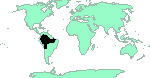 -. See [maps]